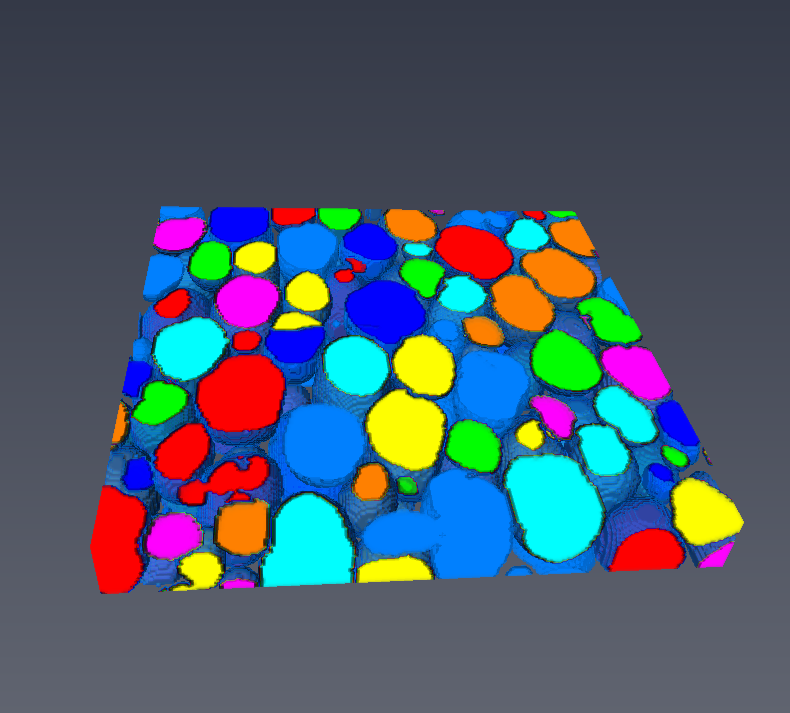
Label Quantification
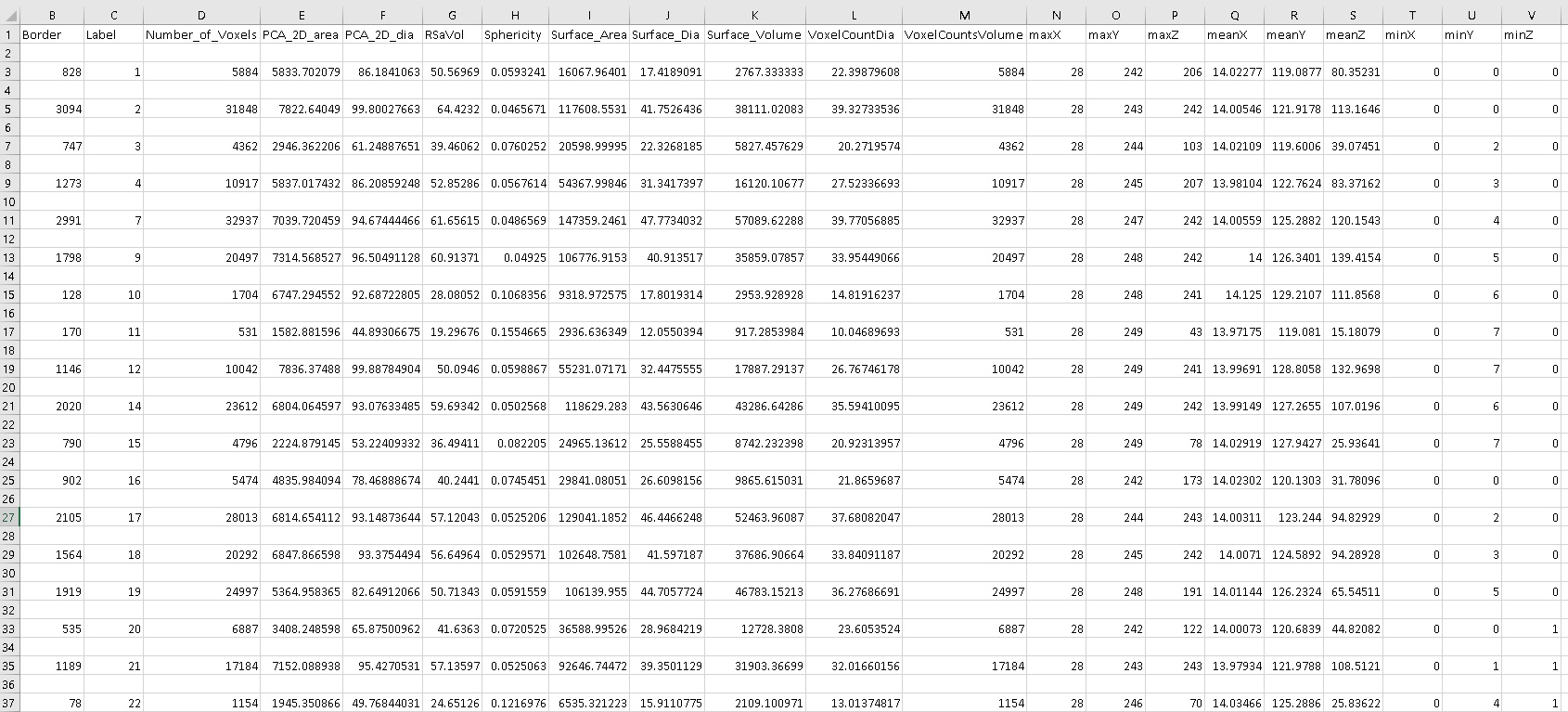
This algorithm takes in a labelled image and calculates several characteristics for each label. Below are some of the characteristics
- Volume by voxel counts
- Equivalent sphere diameter by voxel counts
- Bounding box diagonal
- Principal Component Analysis (PCA)
- Ellipsoid fitting by PCA
- Equivalent circle diameter by PCA
- Isosurface by marching cude.
- Surface area
- Surface Volume
- Equivalent sphere diameter from surface volume
- Sphercity
- Normalised surface area to volume ratio (Radius*Sa/Vol)
The details of this algorithm are given in Evaluation of 3D bioactive glass scaffolds dissolution in a perfusion flow system with X-ray microtomography. Yue S, Lee PD, Poologasundarampillai G, Jones JR. DOI: 10.1016/j.actbio.2011.02.009
API
LabelQuantification(input_3d_volume, origin, voxel_size, min_data_value, max_data_value, minimum_feature_size)

input_3d_volume: numpy array of 3d volume. data type reflects the function suffix.
origin: numpy array with 3 values.
voxel_size: numpy array representing a voxel size in three dimensions (x,y,z)
min_data_value: minimum value of the input volume
max_data_value: maximum value of the input volume
minimum_feature_size: minimum size of the feature

returns: an list with feature names and another numpy array with each row representing a label and it corresponding values.
Example
To run the example code you need to download the following data file: Foam Data
To run the below code you need to install the following packages:
- tifffile ( conda install -c conda-forge tifffile )
# Imports
from ccpi.quantification.LabelQuantification import LabelQuantification
import numpy as np
import math
from tifffile import TiffFile

    #Read the input volume which is labelled during segmentation
img = TiffFile('FoamData.tif')
data = img.asarray()

    #voxel size
voxel_size = np.ones(3,dtype=np.float32)
    #origin
origin = np.zeros(3,dtype=np.float32)

    #computes the 3d quantification
lqsNames, lqsValues = LabelQuantification(data, origin, voxel_size, float(np.amin(data)), float(np.amax(data)), 100.0)
lqs.compute()

print(lqsNames)
img.close()